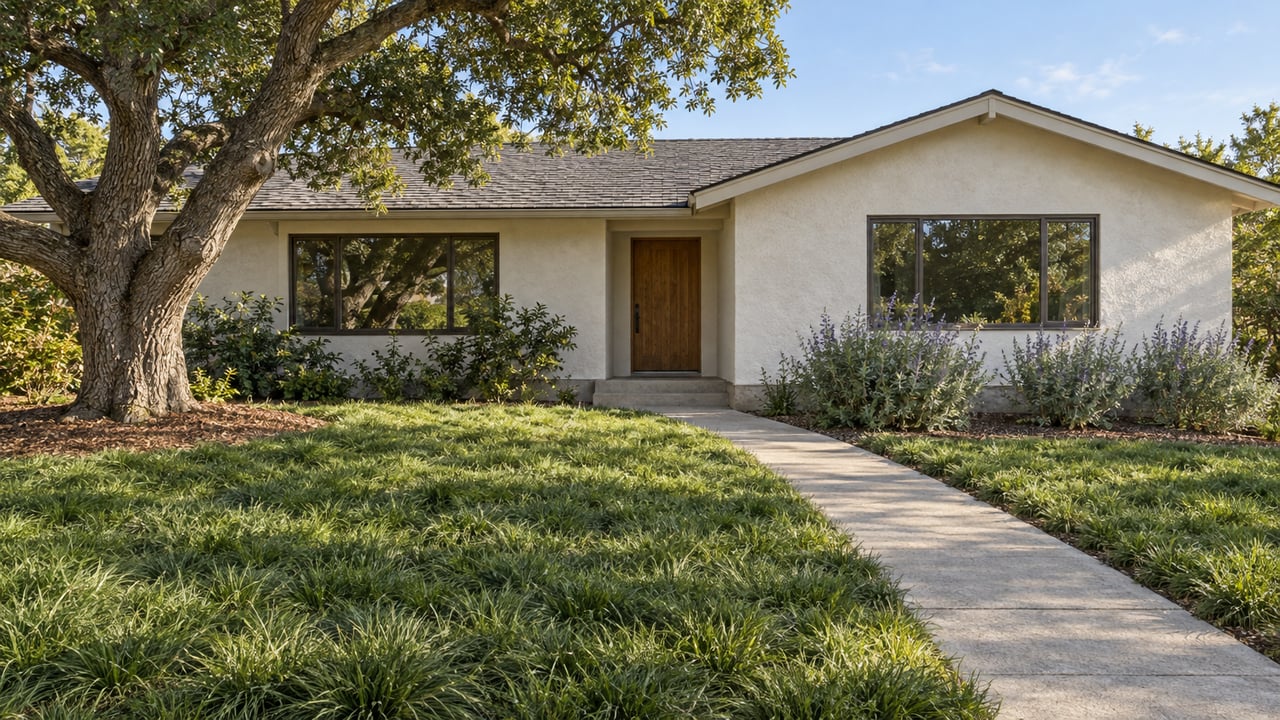
A Brentwood property sold for about $5.3 million in February 2023, a few weeks before Measure ULA took effect. The original house was torn down. A new seven-bedroom, 8,990-square-foot home went up in its place, with a pool, a screening room and a guest house. It came on the market last December at $19.995 million and, after three price cuts, was listed at $15.995 million when the New York Post wrote about it in early October. At that price, the paper estimated the ULA bill at about $880,000.
The houses next door are the more telling part of that story. A Westside broker walking the block with the Post pointed out that the modest older homes beside it could be taxed too, because the land under them is worth more than $5 million on its own. "It's 2,000 feet. Not a mansion, even though it's $5.5 million, because of the land it's sitting on," he said.
That is the part of Brentwood pricing a median price leaves out. In much of this neighborhood, Measure ULA doesn't fall on mansions. It falls on lots. Because of that, it shapes who sells, who stays, and how many move-up homes ever reach the market.
A cliff, not a bracket
The City of Los Angeles Office of Finance states the current rules plainly. For sales closing after June 30, 2026, a transaction above $5,400,000 and below $10,900,000 pays a 4% ULA tax. A transaction of $10,900,000 or more pays 5.5%. Before July 1, the thresholds were $5.3 million and $10.6 million, according to the Los Angeles Times.
The rate applies to the whole price, not just the dollars above the line. One dollar over $5.4 million turns a tax bill of zero into one of about $216,000. Here is what that does to the price minus ULA at a few points near the line:
| Sale price | ULA at 4% | Price minus ULA |
|---|---|---|
| $5,400,000 | $0 | $5,400,000 |
| $5,450,000 | $218,000 | $5,232,000 |
| $5,550,000 | $222,000 | $5,328,000 |
| $5,625,000 | $225,000 | $5,400,000 |
| $6,000,000 | $240,000 | $5,760,000 |
The arithmetic leaves a band of roughly $225,000 above the threshold where the seller keeps less than a $5.4 million sale would leave. A sale at $5.55 million leaves less after the tax than a sale at $5.4 million. Only around $5.625 million does the higher price get back to even, and that's before commissions and other closing costs. The same jump happens at $10.9 million, where the rate goes from 4% to 5.5% on the entire price.
Price ranges like that don't stay empty by accident. A July 2026 study by Pepperdine and Beacon Economics, supported by the Greater Los Angeles Association of Realtors, found that after ULA began, sales in the City of Los Angeles clustered just below the tax thresholds and became less frequent above them. The study covered earlier years and the cutoffs in effect then, especially the original line near $5 million. It doesn't measure clustering at the new $5.4 million mark or in Brentwood specifically.
Why Brentwood lots hit the line before the houses do
In most of Los Angeles, a sale over $5.4 million means a large, finished, high-end house. In Brentwood, the threshold can be crossed by a 2,000-square-foot home whose value is mostly land. That changes who the tax actually lands on.
The owner of a modest older house on a valuable Brentwood lot faces the same cliff as the developer who just finished a new build. The two are in very different positions, though. A developer can price the tax into the next project from day one. An owner who bought decades ago, and whose house has simply been overtaken by the value of its land, gets one choice. Sell and hand the city 4% of the whole price, or don't sell.
One Los Angeles luxury builder says more of its work now comes from owners who chose the second option.
Staying put and rebuilding the house you already own
In July, The Real Deal reported on Gesh Group, a luxury homebuilder that also remodels existing single-family homes. Founder Oren Levy said that before ULA, his firm's work was about 80% new construction and 20% remodels. It's now about 60% remodels and 40% new builds. The remodels have also gotten bigger, often taking a house down to the studs. "In some instances, there's homeowners that are leaving one wall and remodeling everything else," Levy told the publication.
Levy said many of these projects are in Sherman Oaks, Encino, Bel Air and Brentwood, and cost roughly $1 million to $6 million for homes that would sell above the ULA threshold. He described one Brentwood project where the owners had planned to sell. After adding up the tax and agent commissions, which together would have taken about 11% of the sale proceeds, they decided to stay and remodel. "Instead of giving that money away, they reinvested into their current home," Levy said.
When an owner remodels instead of selling, that house stays with its current owner for now, which shapes the timing of what comes up for sale in Brentwood. ULA can affect how many sales happen as well as what each one costs. The Pepperdine and Beacon study estimated that expected monthly high-value transactions in the City of Los Angeles fell about 41% compared with surrounding jurisdictions after ULA took effect. It found no statistically significant effect below the threshold. The authors note that some of those missing sales may reflect repricing below the threshold, delays or relocations rather than deals that never happened.
The tax the buyer won't pay for
If fewer homes come to market, you might expect the ones that do to sell for more. The same research points the other way. In its preferred single-family models, the study estimated that post-ULA sale prices in Los Angeles underperformed surrounding areas by about 6% to 7% overall, and by about 11% to 12% for homes at $5 million and up.
A broker quoted in the same Real Deal piece gave the reason in transaction terms. Sellers want to factor their transfer tax into the asking price, but "buyers generally do not assign additional value to a property simply because the seller has a substantial ULA obligation." He said ULA now comes up in "nearly every meaningful conversation" about timing, pricing, renovation and whether a sale makes sense.
Put those together and the high end of Brentwood has fewer sellers willing to list and buyers unwilling to cover the tax for the ones who do. Remodeling is the way out of that standoff for the owner. Renovation carries its own risks, though. The same broker warned that it is "not necessarily the safer or more economical decision" and that the market may not return the full investment.
For a buyer comparing Brentwood with neighborhoods outside the City of Los Angeles, that means a few concrete things:
- Asking prices just under $5.4 million deserve a closer look. A seller listing there may have priced to stay under the line on purpose. That leaves little room to negotiate upward and some reason to keep the deal below the threshold.
- Listings priced just above the line may come down. A seller pricing a home in that dead zone keeps less than one who sells at $5.4 million.
- New construction carries the tax in its math. Above $10.9 million, a builder's sale owes 5.5% on the full price, which is how the Brentwood rebuild in the Post story arrived at an estimated bill near $880,000.
- Older homes on big lots face the hardest choice. Owners of these houses are the ones weighing a remodel against a sale that crosses the line.
What November 3 won't change
The rules aren't likely to move this fall. On July 1, the Los Angeles City Council voted 14–0 to shelve a proposed November ballot measure that would have exempted new apartment buildings from ULA, LAist reported. A statewide initiative to cap local transfer taxes was pulled in June, according to CalMatters. Its replacement, Proposition 43, would change the voting threshold for certain future local special taxes and would not apply retroactively to existing taxes like ULA. The Secretary of State's list of November 3 measures includes no ULA repeal.
In Sacramento, AB 736, which proposed capping local transfer taxes at 1.5%, had its June 25 committee hearing postponed. The Los Angeles Business Journal described its status as unclear in late September. According to the Los Angeles Times voter guide, Proposition TE, the city measure on the same ballot, would apply only to qualifying fire-damaged properties in Pacific Palisades, not to Brentwood homes.
For anyone planning a Brentwood sale or purchase over the next year, the $5.4 million and $10.9 million lines are the ones to plan around.
FAQ
Does the threshold change again? It has already moved once, from $5.3 million to $5.4 million for sales closing after June 30, 2026. The City's Measure ULA FAQ is the place to confirm the current figures before any closing.
Does ULA apply to every Brentwood address? The City's FAQ describes its transfer tax as applying to documents that convey real property within the City of Los Angeles. Confirm the jurisdiction of any specific parcel during escrow.
Is the tax based on the house or the price? The price. The City describes it as an excise tax on the value of the property interest conveyed, not a tax on the property itself. That's why a small house on a valuable lot can owe it.
This post is general information, not legal, tax or financial advice. If a transfer tax could affect your sale or purchase, confirm your own numbers with a tax professional or real estate attorney.
If you own a Brentwood home whose land value has drifted toward the $5.4 million line, or you're weighing an offer on one near it, Kyle Leibovitch can walk through the pricing math with you before you list, remodel or write an offer. Schedule a consultation.